ClothesGuide
What to do with clothes that are too big after weight loss
Donate, sell, alter, or store? A practical way to sort clothes too big after losing weight — and an honest look at why the expensive ones end up in the attic.
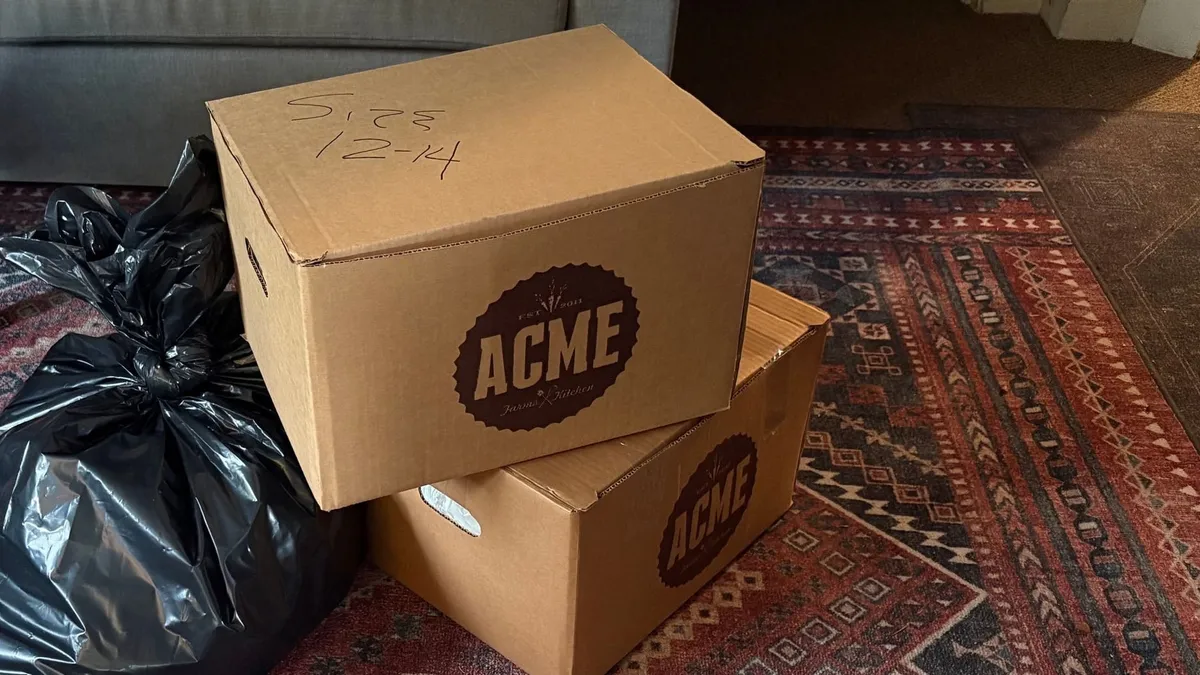
Clothes that are too big after weight loss have four places to go: donation, resale, the tailor, or storage. Sorting them is not the hard part. So far I have made three trips to Goodwill, sent two pairs of pants to be hemmed, sold nothing, and put three boxes in the attic, each marked with a size. The hard part is that the four destinations are not really about the clothes. They are about which version of the last eighteen months you are ready to close out.
Here is the thing that surprised me most: I expected the emotional struggle to be about the biggest sizes — the “before” clothes. It wasn’t. Those were easy. Good riddance. The clothes I cannot seem to let go of are the ones I bought on the way down.
What can leave immediately
Some clothes require no deliberation. Anything low quality. Anything worn out. And anything that fails what I have come to think of as the audacity test:
Even if this fit me perfectly, would I ever have the audacity to wear it?
Weight loss made me more willing to consider clothes I once would not have imagined wearing — louder, more stylish, more conspicuous things. Some of that experimentation was worth it. But the audacity test is not just whether I can summon the nerve. It is whether the clothes make sense in my actual life. I am mostly a jeans-and-sweatshirt person, and some things look wonderful in the mirror yet still feel like a costume once I picture wearing them to the corner bar — not ugly, not boring, not too bold, just slightly borrowed from another person’s life. A gloriously colorful patterned sweater comes to mind: loved on the hanger, worn nowhere. Sometimes I bought clothes before I had acquired the nerve to wear them; sometimes I bought them for a life I do not live. Either way, those can go — the size question is irrelevant, and the donation bag is right there.
Is it okay to keep clothes that are too big “just in case”?
The fear underneath that question deserves a straight answer, because I have it too. The fear of gaining the weight back is constant for me, and it drives more of my decisions than I would like.
So: yes, keeping some clothes is reasonable. Bodies change. Weight can come back. Replacing good outerwear is expensive. A small, deliberate backup is a rational hedge, not a prophecy.
But “keeping the fat clothes in case it comes back” quietly relies on a chain of assumptions — that your body would return to the same proportions, that the style will not have dated, that the fabric survives storage, that you would even want to wear that item again. Every link has to hold for the stored garment to be worth anything. When I actually walk that chain, most items fail somewhere in the middle of it.
Keep a hedge if you need one. Keep it small enough to name from memory.
The clothes that are actually hard to let go
Nobody warned me about this category: the expensive things I bought at temporary sizes, mid-loss, that barely got worn.
I have a navy cocoon jacket from Aritzia that I bought ten months into losing on a GLP-1. I have never worn it. It kind of fits, but a size down would fit better now — it wraps around quite a bit. I have AYR jeans I paid to hem that I have not worn since, because the waist outgrew me before I got the chance. I have AGOLDE denim that started falling off after only a couple of months.
None of these are “fat clothes.” They are milestone purchases — things I bought because I finally could — and they carry a different weight than the old sizes ever did. The old clothes belonged to a size I was relieved to leave behind. These carry the regret of money spent on a size that did not last. I have written separately about what those milestone sizes were doing for me the whole time.
I will be honest about where they are: the attic. I have smoothed away some of the regret by storing the stuff up there.
My Universal Standard pieces never went straight into attic limbo, because their Fit Liberty exchange was the exit the first time — the too-big pair went back and the next size came out. But there is only one exchange. When the replacement stopped fitting too, it still had to leave. The program extends a garment’s life; it does not eliminate the eventual decision.
The two questions that settle it
For anything that is not an obvious donation and not part of a small deliberate hedge, two questions do the sorting:
If this fit me today, would I be glad to wear it? If I saw it in a store today, would I buy it again?
An item that fails both is finished, whatever it cost. The price is doing the emotional work, not the garment. Two formal dresses came out of my closet this week that I have never worn once; they fail both questions, and they should just go.
The questions also catch the keepers. A linen shirt-and-skirt set of mine passed — it is honestly a little boring, but the fit is genuinely flattering, and I should absolutely wear it. Whether I actually will is its own experiment.
Is it worth selling clothes that don’t fit?
People will tell you to recover money on resale platforms. I have sold exactly nothing. I find it too much trouble, and I am scared of getting ripped off.
If selling works for you, sell. But if the unsold pile is sitting there because listing feels like a second job, you have my permission to skip the middle step and donate.
What I keep, and what keeping has taught me
The keep I stand behind: a pair of baggy linen pants with an elastic waist and a drawstring. I talked myself into keeping them, and I am still wearing them — the adjustable features did exactly what they are supposed to do across the size changes.
But I want to be honest about the pattern. I do not regret anything I have let go — not one item. The regret runs entirely the other way: things I kept, looked at months later, and wondered what I was thinking. If your experience matches mine, the risk is not donating too much. It is keeping too much, in too many sizes, for too many hypothetical futures.
You do not have to finish this in a weekend
I have not finished it either. So far I have properly sorted exactly one drawer — the short-sleeve tees — and there is a pile waiting for one more pass before it gets boxed or bagged. Deciding what to buy during the change turned out to be only half the job. The other half is here: the drawer, the pile, and the boxes with sizes written on them.
The boxes in my attic are marked with sizes I will probably never wear again. I am keeping them for now, and I know what they are: not a wardrobe, a decision I have postponed. Whenever I do open them and walk the two questions through what’s inside, I already suspect what most of the answers will be.
That is allowed too. This process does not grade you on speed.
Nora from What Fits Now
New pieces by email
The email list is coming soon.